











 New
Data & Analytics Python
 Pandas
 NumPy
 Jupyter
 Matplotlib
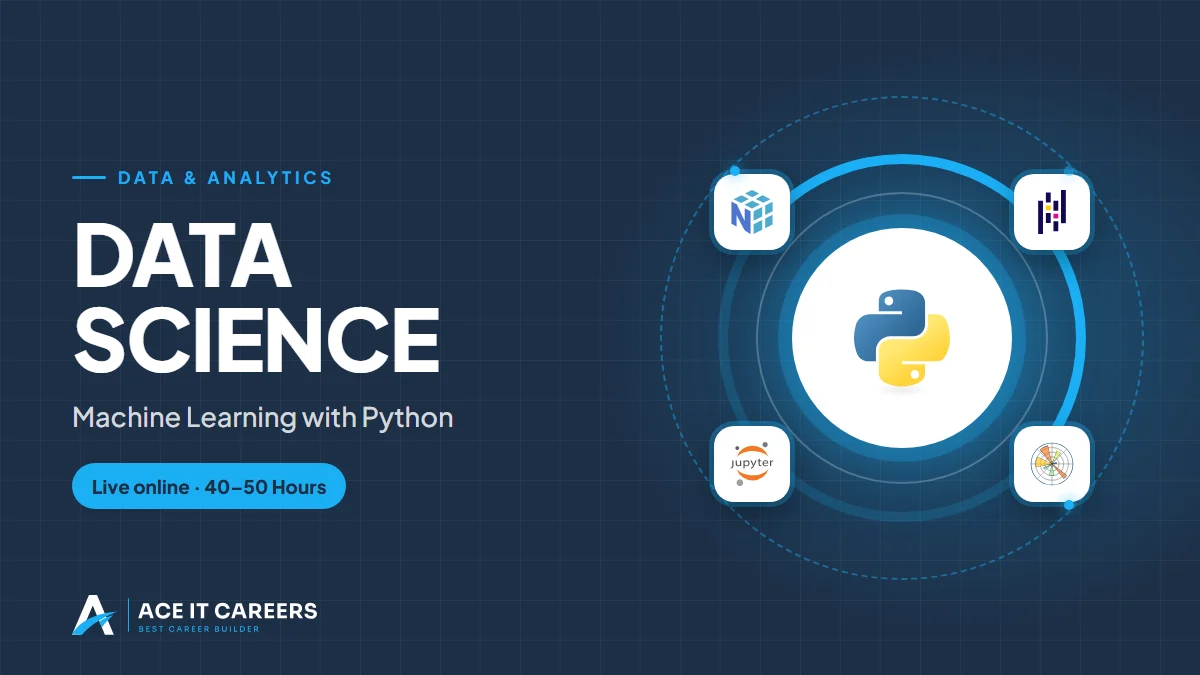
Data Science with Python
Live online training with real-time projects, then resume marketing, mock interviews and placement support with US employers.
PythonPandasNumPyJupyterMatplotlib- Live instructor-led classes
- Real-time project work
- Resume writing & marketing
- Mock interviews & placement
Course overview
This course is designed and conceived by leading experts in Python programming. This Python Data Science certification program can help you be a proficient and commanding Python programmer. This online training program is packed with the necessary information and knowledge required for you to be a successful data science Python developer.
Data science is the study of data in the form of statistics, graphs, mathematical models for data analysis for various needs. Therefore programming for data science with python is the most preferred and efficient. This python data science tutorial will provide you with all the fundamentals of python programming. This program will make you efficient in dealing with data manipulation and cleaning techniques using data science python libraries. Data science without Python would be a difficult thing to crack.
Key features
- Learning concepts of data science python visualization
- Insight into python data science libraries
- We Will Provide Course certification guidance
- Access to real-life scenarios.
- Help you with interview questions and answers
From Python fundamentals and data analysis to statistics, visualization and machine learning, ending with a complete end-to-end project. 10 modules and about 40 to 50 hours of live training.
What you will be able to do
- Write Python programs for data processing and analysis
- Work with NumPy arrays and Pandas DataFrames
- Import, clean, transform and analyze real-world datasets
- Create meaningful visualizations with Matplotlib and Seaborn
- Apply descriptive statistics and introductory probability
- Build and evaluate machine learning models with Scikit-learn
- Complete an end-to-end data science project and explain the findings
Syllabus
Download syllabus PDF01Module 1Introduction to data science7 topics
- What is data science?
- Data science vs data analytics vs machine learning vs AI
- Applications in banking, healthcare, retail, education and e-commerce
- Structured, semi-structured and unstructured data
- The data science lifecycle
- Datasets, features, labels and observations
- Setting up the Python environment
Practical: Explore a student-marks dataset and identify patterns in performance.
02Module 2Python programming fundamentals8 topics
- Variables, data types, operators and type conversion
- Conditional statements and loops
- Strings, lists, tuples, sets and dictionaries
- Functions, arguments, return values and lambda functions
- List comprehensions and exception handling
- Modules and packages
- Reading and writing CSV and text files
- Introduction to classes and objects
Practical: Calculate student grades, find highest and average marks, count word frequencies and summarize salaries from a CSV file.
03Module 3NumPy for numerical computing6 topics
- One-dimensional and multidimensional arrays
- Indexing, slicing and reshaping
- Vectorized operations and broadcasting
- Aggregate functions: sum, mean, min, max, std
- Boolean indexing
- Random numbers and basic matrix operations
Practical: Analyze examination marks with NumPy arrays, without repetitive loops.
04Module 4Pandas for data analysis (key module)9 topics
- Series and DataFrames
- Importing CSV and Excel files
- Exploring data with head, tail, info and describe
- Selecting, filtering, sorting and ranking
- Handling missing values and duplicates
- apply, groupby and aggregation
- merge, join and concat
- Dates, categorical data, pivot tables and cross-tabulation
- Exporting to CSV and Excel
Practical: Analyze an employee dataset: headcount by department, average salary, top earners and missing data.
05Module 5Data cleaning and exploratory data analysis6 topics
- Assessing dataset quality
- Missing, inconsistent, duplicate and invalid records
- Outliers and their causes
- Univariate, bivariate and multivariate analysis
- Correlation, covariance and frequency distributions
- Turning business questions into analytical tasks
Practical: Analyze retail sales: best sellers, monthly trends and underperforming categories.
06Module 6Data visualization5 topics
- Matplotlib line, bar, histogram, pie, scatter and box plots
- Titles, labels, legends, annotations and subplots
- Seaborn count, distribution, box and violin plots
- Heatmaps and correlation matrices
- Choosing the right chart and avoiding misleading visuals
Practical: Build a sales-analysis report with at least five different charts.
07Module 7Statistics and probability7 topics
- Population and sample
- Mean, median, mode, range, variance and standard deviation
- Percentiles, quartiles and the normal distribution
- Probability rules, conditional probability and Bayes' theorem
- Sampling bias and the central limit theorem
- Confidence intervals and hypothesis testing
- p-values, correlation vs causation and A/B testing
Practical: Compare the average spending of two customer groups and test whether the difference is significant.
08Module 8Introduction to machine learning5 topics
- Supervised and unsupervised learning
- Regression, classification and clustering
- Training and testing data, features and targets
- Overfitting and underfitting
- Scikit-learn and the machine learning workflow
Practical: Train a simple model to predict house prices.
09Module 9Machine learning algorithms with Scikit-learn6 topics
- Linear and polynomial regression; MAE, MSE, RMSE and R²
- Logistic regression, KNN, decision trees and random forests
- Confusion matrix, accuracy, precision, recall and F1-score
- K-means clustering and PCA
- Feature scaling and encoding categorical variables
- Cross-validation, hyperparameter tuning and data leakage
Practical: Predict house prices, predict customer churn and segment customers by purchasing behavior.
10Module 10End-to-end project and career preparation6 topics
- Understanding the business problem
- Cleaning, exploring and visualizing a real-world dataset
- Selecting, training and evaluating a model
- Documenting findings and limitations
- Presenting results to a non-technical audience
- Building a project portfolio and discussing it in interviews
Practical: Final deliverable: a complete Jupyter Notebook with code, visualizations, analysis and a project report.
Who should take this course?
This Python Data Science course is will be useful for professionals with a flair for programming. This course will also help beginners and individuals who want to pursue a career in the programming field. This training program will make you learn and understand Python Programming from scratch.
Roles you can apply for
Data AnalystData ScientistML Engineer (junior)
Get course details & fees
How it works
From registration to your first offer
Training is only half the job. One team guides you through every stage until you're hired.
Register & get counselledPick the right course for your background with a free advisor call.
Step 1 of 5Related
You may also like
New
FAQ
Data Science course FAQ
Who can join the Data Science course?+
This Python Data Science course is will be useful for professionals with a flair for programming. This course will also help beginners and individuals who want to pursue a career in the programming field. This training program will make you learn and understand Python Programming from scratch.
How long is the Data Science course?+
The live training runs 40-50 hours, followed by resume preparation, resume marketing and interview preparation.
Is placement support included?+
Yes. After training we prepare your resume, market your profile to hiring employers and prepare you with mock interviews before client interviews.
Do I get a certificate?+
Yes. You receive an Ace IT Careers certificate that employers can verify online.
Start your Data Science career
Book a free demo class and get the full syllabus, batch dates and fees.